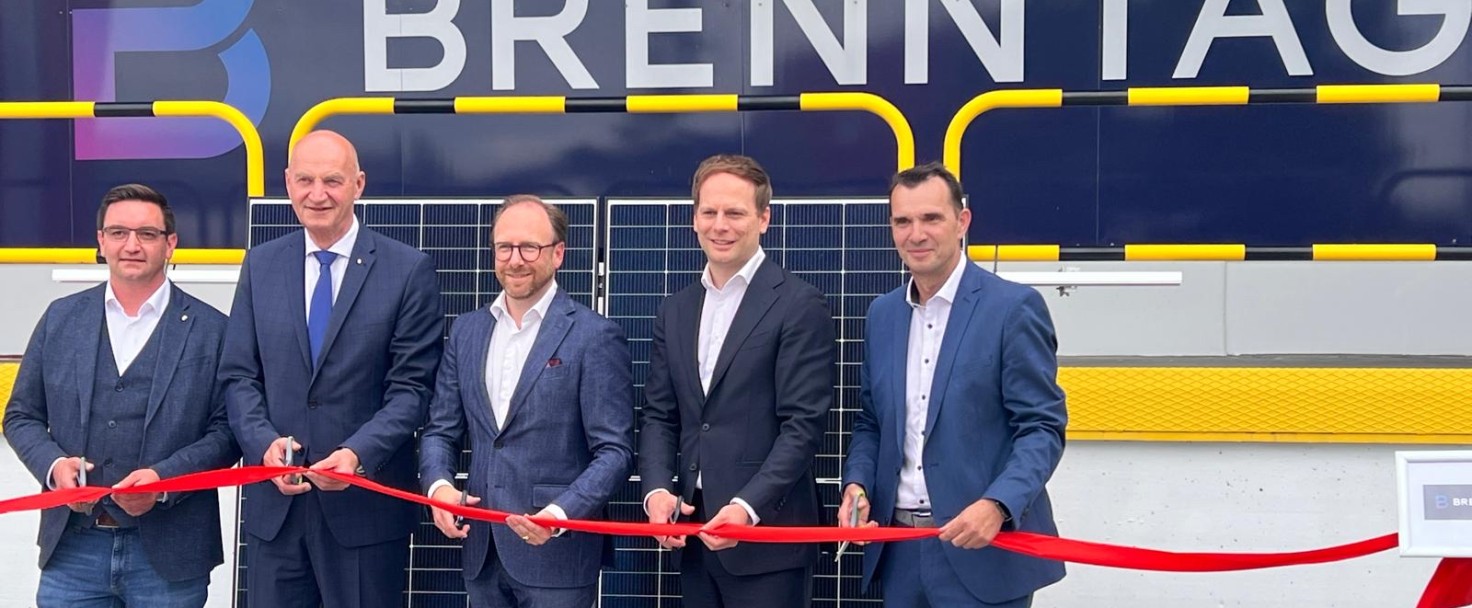
- Political representatives welcomed the sustainable investment and showed great interest in the modernized site in one of Europe's most important industrial regions.
- Brenntag proves that it is possible to operate a chemical distribution site in a completely climate-neutral manner.
Brenntag, the global market leader in the distribution of chemicals and ingredients, inaugurated its first CO2-emission-free site worldwide in Traun, Upper Austria, on Friday, May 30, 2025.
Over the past few months, the Traun plant has undergone extensive energy efficiency upgrades and a complete overhaul of its energy system. The site now serves as a blueprint and global flagship project for Brenntag's approximately 600 other locations in more than 70 countries worldwide.
Representing politics and the public were Provincial Councilor Dr. Christian Dörfel, representing the Provincial Governor, the custodian of St. Florian's Abbey Basilica, Mag. Harald Ehrl, and the mayor of Traun, Ing. Karl-Heinz Koll, who attended the inauguration.
Emanuel Guelfenburg, Managing Director of Brenntag Austria, welcomed Benjamin Deister, Regional President of Brenntag Essentials EMEA Central, as representative of Brenntag's management. In addition to Austria, Brenntag's EMEA Central region comprises around 15 other countries in Central and Eastern Europe and generates sales of around 1.5 billion euros with more than 2,000 employees.
A total of over €1.5 million was invested at the Traun site – in reducing energy consumption through thermal building renovation and control technology optimization of the heated acid/alkali tanks, converting the heating system to a groundwater heat pump and low-temperature radiators, and covering the electricity requirements for the heat pump, site consumers, and electric charging stations by installing a photovoltaic system.
The total savings amount to around 120 tons of CO2 per year, which corresponds to the total energy consumption of around 50 households per year. With 220 kWp, the photovoltaic system will generate around 220,000 kWh of electricity per year, thus covering the annual consumption of the two heat pumps (73 and 110 kW).